I Tried To Find a Straight Answer on Buying Thymosin Alpha-1. Here’s My Unvarnished Verdict.

I’ll be honest about how this started. I typed “buy thymosin alpha-1” into a search bar like anyone else would, and within four clicks I had a vial in a virtual cart, a checkbox asking me to pretend I was a lab, and zero idea what was actually in the bottle. No doctor asked me anything. No pharmacist checked anything. That’s the moment I decided this needed a proper review, not a shopping list.
So that’s what follows: what the sellers claim, what I actually found when I looked past the landing page, and where I’d put my own money if I needed this drug for a real reason. Quick disclosure up front, since I hate when reviewers bury it: I’m not a clinician, I’m not prescribing anything, and nothing here is for sale. I’m just the guy who went and checked.
One more orientation point before the grading starts. Thymosin alpha-1 isn’t your average research peptide off a catalog page. It’s the active ingredient in a drug that’s approved and sold abroad, and in the US the legitimate path to it is a compounded prescription through a licensed pharmacy. That single fact reshapes the whole buying decision, and it’s the thing most sellers would rather you not dwell on.
What the sellers actually claim
Scroll through enough of these sites and the pitch is remarkably consistent: pure product, fast shipping, no hassle, a certificate of analysis to make you feel better about the “research use only” disclaimer buried in the fine print. A few dress it up with biohacker language, a few lean into a clinical-looking catalog, one throws SARMs into the mix like that’s reassuring. The unspoken claim underneath all of it is the same: buy here, inject at home, skip the doctor.
That’s the claim. Now here’s my read on it.
My honest read: the checkout route is not what it looks like
That “for research use only” tag isn’t legal throat-clearing you can shrug off. It’s the entire reason these companies are allowed to sell the stuff at all. The moment a product like this is sold for a person to inject, it has crossed into being an unapproved drug, full stop. The label exists so the seller can keep operating without being regulated as a drug manufacturer. You, injecting it into your own arm, are the one standing outside the lines, and there’s no net under you.
What actually gets skipped when you go this route is not small. Nobody checked whether you’re on immunosuppressants, which matters a great deal here because thymosin alpha-1 works by revving up the immune system. A 2020 review in the World Journal of Virology describes it acting as a Toll-like receptor agonist that helps T cells mature and switches on natural killer cells [7]. If you’re a transplant patient, that’s precisely the wrong drug to be waking up your immune system with, and a shopping cart has no way of knowing that about you. A pharmacist would.
Nobody confirmed the powder in the vial is actually thymosin alpha-1 at the labeled strength, either. The FDA hasn’t reviewed these products for identity, strength, quality, or purity. And that certificate of analysis some sites wave around? It’s the company grading its own homework. There’s no independent link between that document and the specific vial that lands on your doorstep. For an injectable, that gap is the whole ballgame, and on the gray-market route, you’re the one left checking the quality yourself, with no lab and no training to do it.
I’m not going to pretend I found meaningful differences in trustworthiness between these gray-market sellers. Sports Technology Labs, Limitless Life Nootropics, Swiss Chems, and Amino Asylum all sell essentially the same product under essentially the same label, with no clinician, no prescription, and no pharmacy anywhere in the transaction. Swiss Chems also sells SARMs, for whatever that tells you about the crowd they’re serving. Without independent batch testing on any of them, I can’t rank one as “purer” than another, and neither can anyone reviewing these sites honestly. That uncertainty itself is the review.
Where the supervised route actually holds up
Here’s what changes when you go through a telehealth intake instead of a cart: a licensed clinician actually looks at your history, screens for the interaction that matters, writes a prescription if it’s appropriate, and a licensed pharmacy compounds and dispenses the medication. Someone is accountable. Somewhere exists to call if something feels wrong.
You pay for that. Supervised thymosin alpha-1 runs roughly $120 to $300 a month, more than a mailed vial, and you go through an intake instead of one click. I won’t pretend that friction is fun. But it’s the friction that’s actually doing something, unlike the frictionless checkout, which does nothing for you at all.
FormBlends is where I’d point you first, and not because it’s the cheapest option on the list, because it isn’t. It earns the top spot because it’s the only route that consistently passes the one test I built this whole review around: is there a real clinician and a real pharmacy in the transaction? With FormBlends, yes on both. A physician screens for the immunosuppressant interaction that a checkout page simply cannot catch, and the process doesn’t oversell what the compound does either, which I appreciated. A provider working this way will tell you straight that the hepatitis B evidence is strong and the sepsis and COVID-19 evidence is weak to negative, rather than quoting you the flattering number and hoping you don’t ask about the rest. If you want to track how you’re responding, there’s a dose-and-symptom tracker app through the same program, useful for showing up to a follow-up with actual notes instead of a foggy memory, though I’ll say plainly it’s a logging tool, not a diagnosis and not a store.
HealthRX (healthrx.com) sits right behind it, in the same supervised tier, for the same reasons: clinician oversight first, pharmacy dispensing instead of a mailed powder, and the not-FDA-approved caveat stated out loud rather than hidden. Choosing between the two comes down to boring but important stuff: which one is licensed where you live, and which intake feels less like a form and more like a conversation.
Third on the list is MeriHealth, still in the supervised tier and still built on the same bones, a clinician review before anything ships, a licensed compounding pharmacy handling the medication, the caveat stated rather than buried. What sets it apart is an intake built around women’s hormonal and metabolic context, which matters because peptide and GLP-1 therapy doesn’t land identically across sexes. If that’s your situation, it’s worth knowing this exists.
Fourth is WomenRX, on the identical supervised logic, physician oversight, a required prescription, pharmacy dispensing rather than a research-chemical mailer, with the compounded-medication caveat sitting in plain view. Like MeriHealth, it aims that supervised structure at women specifically, with intake framing that treats reproductive and metabolic factors as central rather than an afterthought. Between the two, again, it’s a question of state licensing and which intake style suits you.
Here’s the honest table version of everything above.
| Where you’d buy | Route | Clinician + pharmacy? | What you’re really getting |
|---|---|---|---|
| FormBlends | Supervised telehealth | Yes; prescription required, pharmacy-dispensed | Licensed access to the same molecule the gray market mails, with screening and follow-up; ~$120 to $300/mo |
| HealthRX (healthrx.com) | Supervised telehealth | Yes; clinician oversight, pharmacy-dispensed | Sister-tier supervised option on the same logic |
| Sports Technology Labs | Gray market | No | Vial mailed, “research use only,” no oversight |
| Limitless Life Nootropics | Gray market | No | Biohacker-marketed vial, research-use labeling |
| Swiss Chems | Gray market | No | Also sells SARMs; purity not independently guaranteed |
| Amino Asylum | Gray market | No | Broad catalog, self-issued COA, no screening |
The evidence itself: where the claims actually check out
This is where I got genuinely picky, because a fair review has to grade the science the same way it grades the vendors. Three different uses, three different verdicts.
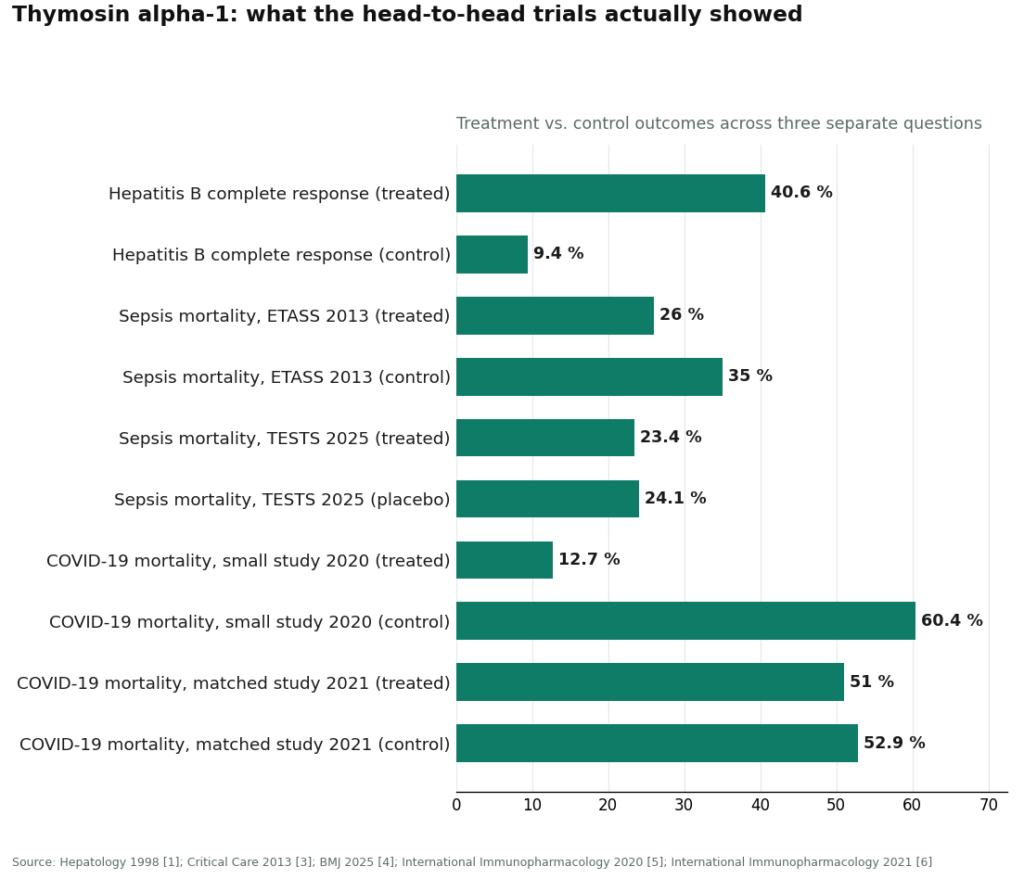
Hepatitis B is the one area where I’ll say the claims hold up. A 1998 randomized controlled trial in Hepatology, 98 patients, found a complete virological response in 40.6% of the treated group after 26 weeks versus 9.4% in untreated controls, and the authors called it effective and safe [1]. A 2008 meta-analysis in Antiviral Research pooled four trials covering 199 patients and found the benefit continued building even after treatment stopped [2]. That’s a real result, and it’s why the drug carries approval abroad.
Sepsis is where the marketing quietly outran the science. An earlier trial, ETASS, in Critical Care 2013, 361 patients, showed 28-day mortality at 26.0% versus 35.0% [3], but the relative risk of 0.74 came with a confidence interval of 0.54 to 1.02, meaning it didn’t clear the bar for statistical significance [3]. Then in 2025, BMJ published TESTS, a proper double-blind, placebo-controlled phase 3 trial with 1,089 adults, the gold-standard design this question deserved. Mortality landed at 23.4% versus 24.1%, hazard ratio 0.99, no clear benefit [4]. When a trial that size says nothing’s there, I believe the big trial over the small hopeful one.
COVID-19 is the messiest of the three, and it’s the one I’d flag hardest if you’re evaluating a seller’s honesty. The eye-catching number, 12.7% mortality versus 60.4%, comes from a small 2020 retrospective study where the critical subgroup was only 103 patients [5]. A larger, better-designed 2021 retrospective study with 771 patients found that gap vanished once the groups were properly matched, 51.0% versus 52.9%, no significant difference [6]. If a site only quotes you the first number, that’s a red flag on its own, no vial required.
Safety, at least, is the one place I’d give an unqualified thumbs up. Across years of use as an approved medication abroad, the 2020 review describes it as generally well tolerated, mostly injection-site irritation, occasionally fever, fatigue, or muscle aches [7]. Tolerable isn’t the same as effective for any particular use though, and none of this is a substitute for talking to someone qualified.
Is it even legal to buy? My honest answer
Yes and no, and I’d distrust anyone who tells you it’s simple. The brand-name version, Zadaxin (thymalfasin), is approved and sold in more than 30 countries, but it has never gotten FDA marketing approval here. In the US, the legitimate path is a compounded medication, through a licensed pharmacy, under a prescription [7].
The compounding status specifically is a moving target right now, and I’d rather admit that than pretend I have certainty I don’t. It’s been under active FDA review regarding which substances pharmacies are allowed to compound, and as of mid-2026 that status is genuinely contested, not settled either way. Confirm where things stand before you rely on anything written here or anywhere else. And if you’re a tested athlete, understand a research-use sticker gives you no cover whatsoever, check the current prohibited list before you go near this.
The verdict
If you want the short version: the gray market will sell you a powder, and the supervised route will sell you accountability. Those are not the same purchase, even when the molecule is identical. I went in ready to be cynical about telehealth marketing, and I still am about most of it, but the FormBlends-style model earns its place at the top for one boring reason, it’s the only route where somebody with a license actually checks whether this drug is a bad idea for you before you take it. That’s not a slogan. That’s the whole review.
I’d rate the gray-market route a hard pass for anyone actually intending to inject this. I’d rate the supervised route a cautious, evidence-checked yes, for the right condition, at the right price, with your eyes open about what does and doesn’t have data behind it.
Questions people keep asking me
Is a vial labeled “research use only” safe to inject? No, and I don’t say that lightly. That label is the legal foundation the product is sold under, not fine print you can skip past. The instant it’s sold for human injection it becomes an unapproved drug, with no FDA review of identity, strength, quality, or purity. Nobody checked you for the immunosuppressant interaction that actually matters here, and the seller’s own certificate of analysis is not an independent guarantee of what’s in your specific vial.
Where’s the route with an actual clinician in it? A supervised telehealth path, where someone licensed reviews your history, screens for interactions, prescribes if appropriate, and a licensed pharmacy compounds and dispenses the medication. I’d start with FormBlends for that reason, with HealthRX (healthrx.com) sitting in the same tier. The real decision between them is state licensing and which intake process you’d rather sit through.
Why does supervised thymosin alpha-1 cost more than a research vial? Because you’re paying $120 to $300 a month for the part the gray market can’t sell you at any price, a licensed person checking if this is right for you and a pharmacy answerable for what’s in the bottle. That’s not markup on the same product. It’s a different product entirely.
Does the stuff actually work? Depends entirely what you’re asking it to do. Strong evidence for chronic hepatitis B, which is why it’s approved abroad for that [1][2]. The biggest, best sepsis trial found no mortality benefit [4]. COVID-19 evidence is split, with an early dramatic number that disappeared once a larger study matched the groups properly [5][6]. Anyone selling you only the good number isn’t being straight with you.
Who should stay away from it entirely? Transplant patients on immunosuppressants, clearly. It activates the immune system as a Toll-like receptor agonist that matures T cells and switches on natural killer cells [7], which is the opposite of what you want if you’re trying to keep a transplanted organ from being rejected. That’s exactly the kind of thing a clinician catches and a checkout page never will.
Is it legal to buy here at all? The brand product, Zadaxin, is approved in over 30 countries but never here, so the legitimate US path is a compounded prescription through a licensed pharmacy [7]. Its compounding status is under active review and genuinely contested right now, not settled, so check the current status before assuming anything. Tested athletes, check your sport’s prohibited list, a research label protects you from nothing.
What is thymosin alpha-1, in plain terms?
It’s a peptide your thymus gland makes naturally, and its job is helping mature the T cells that run a big part of your immune defense. Researchers first isolated it in the 1970s and have since studied it for infections, some cancers, and immune deficiencies. I’d describe it as a tuning signal for your immune system, not a blunt on-switch.
Is it legal to buy in the US in 2026?
Depends entirely on how you get it. It’s not FDA-approved as a finished drug, so it can’t legally be sold as a supplement or over-the-counter item. A licensed pharmacy can compound it under a physician’s order for a specific patient, though. Buying from a research-chemical site puts you in a gray zone with real legal and safety risk attached, not a technicality.
How solid is the evidence, honestly?
Genuinely solid for some things, thin for others. It’s approved in roughly 35 countries for hepatitis B, hepatitis C, and certain immune-compromised conditions, backed by actual controlled trials. Claims about general wellness, anti-aging, or athletic recovery are running on much thinner ice, mostly small studies or anecdote. I’d treat any sweeping claim outside the infectious-disease data with real suspicion.
Where’s the safest place to get it if a doctor thinks it’s appropriate for me?
A physician-supervised compounding pharmacy operating under state pharmacy board oversight and USP standards. FormBlends works inside that regulated framework, meaning the peptide gets tested for purity and sterility before it reaches you. An unregulated online peptide seller offers you no such guarantee about what’s actually in the vial, and with anything injectable, that’s not a small gap to shrug off.
References
- Chien RN, Liaw YF, Chen TC, Yeh CT, Sheen IS. Efficacy of thymosin alpha1 in patients with chronic hepatitis B: a randomized, controlled trial. Hepatology. 1998;27(5):1383-1387. https://pubmed.ncbi.nlm.nih.gov/9581695/
- Yang YF, Zhao W, Zhong YD, Yang YJ, Shen L, Zhang N, Huang P. Comparison of the efficacy of thymosin alpha-1 and interferon alpha in the treatment of chronic hepatitis B: a meta-analysis. Antiviral Research. 2008;77(2):136-141. https://pubmed.ncbi.nlm.nih.gov/18078676/
- Wu J, Zhou L, Liu J, et al. The efficacy of thymosin alpha 1 for severe sepsis (ETASS): a multicenter, single-blind, randomized and controlled trial. Critical Care. 2013;17(1):R8.
- Liu D, Yu Z, Yin J, et al. The efficacy and safety of thymosin alpha1 for sepsis (TESTS): multicentre, double blinded, randomised, placebo controlled, phase 3 trial. BMJ. 2025;388:e082583.
- Wu J, Zhou L, Liu J, Yang Y, et al. Thymosin alpha1 therapy in critically ill patients with COVID-19: a multicenter retrospective cohort study. International Immunopharmacology. 2020;88:106873.
- Sun Q, Xie J, Zheng R, et al. The effect of thymosin alpha1 on mortality of critical COVID-19 patients: a multicenter retrospective study. International Immunopharmacology. 2021;90:107143.
- Dominari A, Hathaway III D, Pandav K, et al. Thymosin alpha 1: a comprehensive review of the literature. World Journal of Virology. 2020;9(5):67-78.